

Posters
Real astrophotography on premium paper.
Posters
Shop
from $24.99
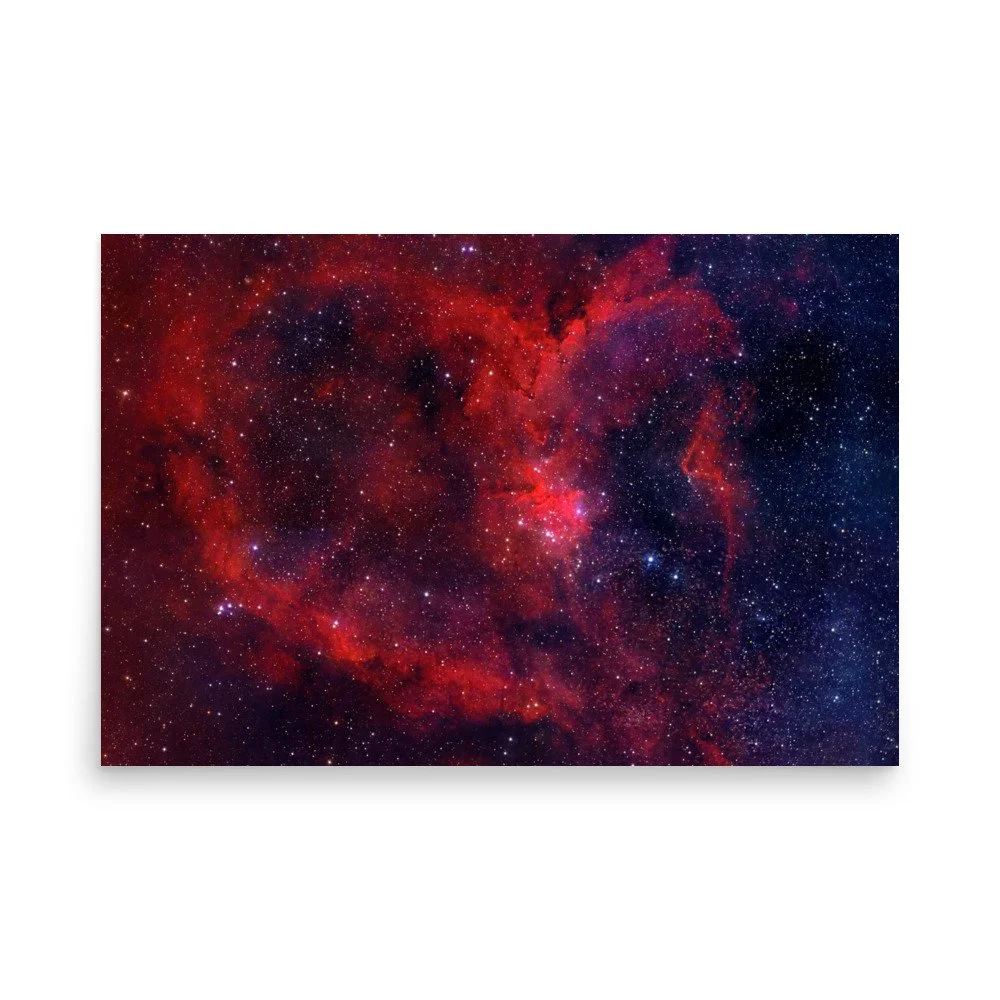
The Heart Nebula on your wall — and a stellar nursery still actively making new stars 7,500 light-years away in Cassiopeia. This isn't a digital painting. It's IC 1805, photographed through my own telescope and printed on premium poster paper.
The heart-shaped silhouette comes from a cluster of young, massive stars at the nebula's center, sculpting the surrounding hydrogen with their winds and radiation. The red glow is the gas itself, ionized and re-emitting at a single sharp wavelength — the signature color of hydrogen, the most abundant element in the universe.
Real astrophotography. No AI, no stock. Just deep sky on your wall.
Read more →
The heart-shaped silhouette comes from a cluster of young, massive stars at the nebula's center, sculpting the surrounding hydrogen with their winds and radiation. The red glow is the gas itself, ionized and re-emitting at a single sharp wavelength — the signature color of hydrogen, the most abundant element in the universe.
Real astrophotography. No AI, no stock. Just deep sky on your wall.
from $24.99
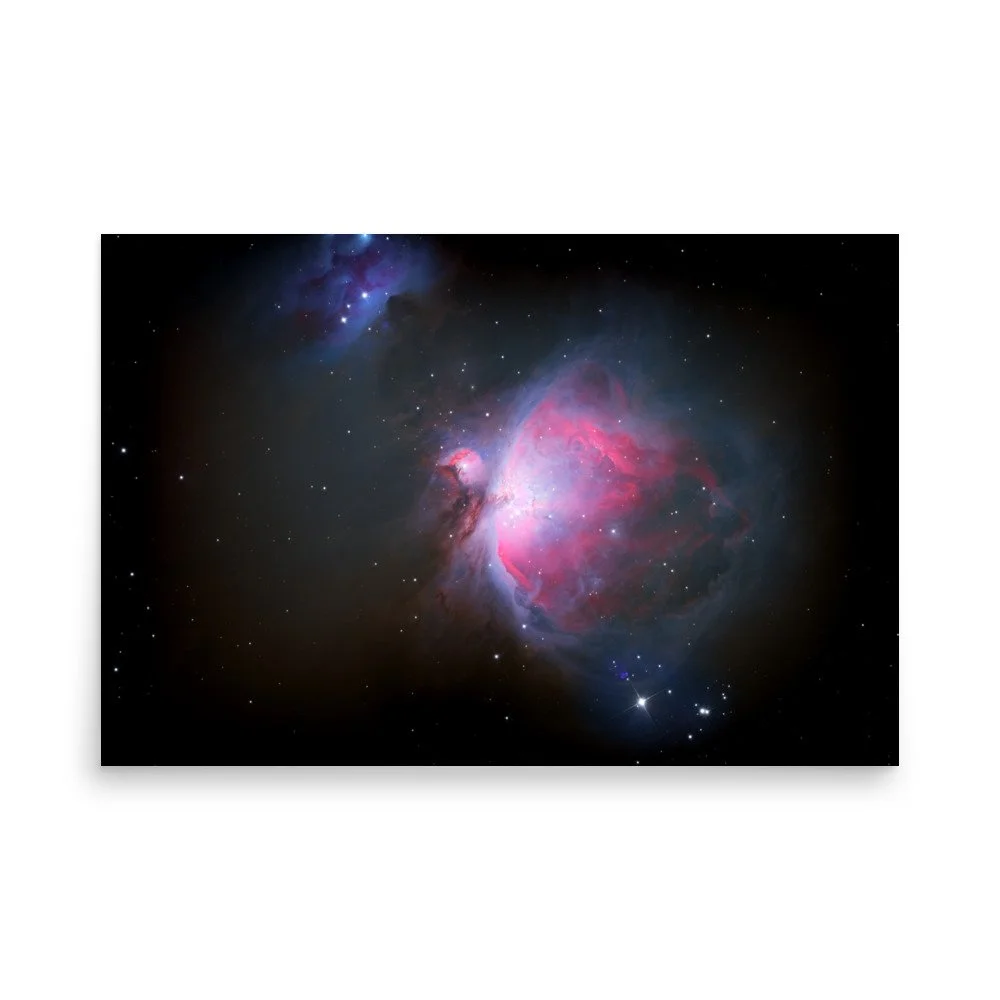
Probably the most photographed object in the night sky — and one you've already seen with your own eyes. The Orion Nebula (M42) is the fuzzy "star" in Orion's sword. With a telescope, it opens into this: a stellar nursery 1,300 light-years from Earth, glowing in hydrogen reds and reflected starlight blues.
The Trapezium — a tight cluster of four bright young stars at the nebula's heart — is what powers the whole scene, blasting it with ultraviolet light and carving the cavities you can see in the gas. Inside Orion, new stars are actively being born right now. Some of them will outlive our sun many times over.
Real astrophotography, captured through my own telescope. No AI, no stock. The closest stellar nursery to Earth, hanging on your wall.
Read more →
The Trapezium — a tight cluster of four bright young stars at the nebula's heart — is what powers the whole scene, blasting it with ultraviolet light and carving the cavities you can see in the gas. Inside Orion, new stars are actively being born right now. Some of them will outlive our sun many times over.
Real astrophotography, captured through my own telescope. No AI, no stock. The closest stellar nursery to Earth, hanging on your wall.
from $24.99
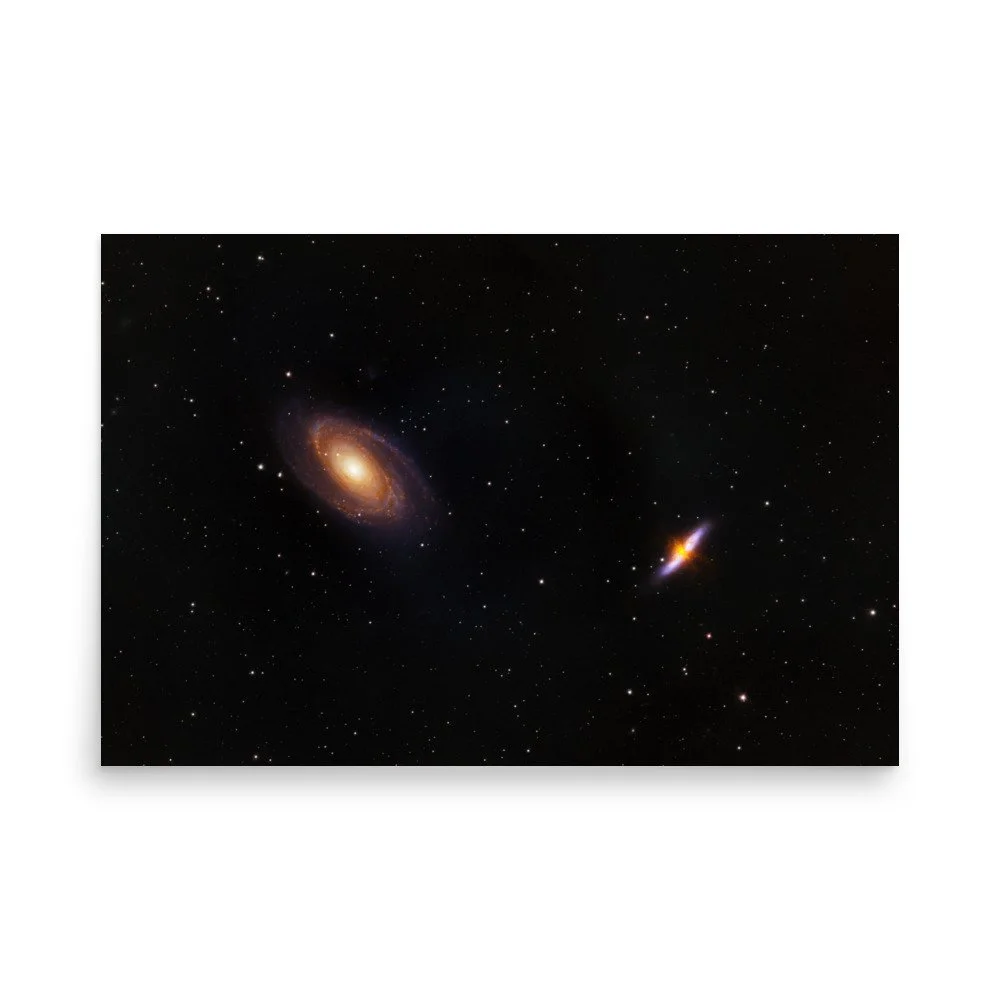
Two galaxies in one frame — Bode's Galaxy (M81) and the Cigar Galaxy (M82), captured together through my own telescope from 12 million light-years away. They're a famous pair in Ursa Major, gravitationally locked together and visually stunning side by side.
M81 is the calm one: a textbook spiral, ~90,000 light-years across, arms tracing outward in elegant curves. M82 is its violent neighbor — an edge-on starburst galaxy with intense red jets of gas exploding outward from its core, the result of a near-collision with M81 around 600 million years ago. The pair tells a quiet story about how galaxies meet, deform, and keep going.
Real astrophotography. No AI, no stock. Two galaxies, side by side, on your wall.
Read more →
M81 is the calm one: a textbook spiral, ~90,000 light-years across, arms tracing outward in elegant curves. M82 is its violent neighbor — an edge-on starburst galaxy with intense red jets of gas exploding outward from its core, the result of a near-collision with M81 around 600 million years ago. The pair tells a quiet story about how galaxies meet, deform, and keep going.
Real astrophotography. No AI, no stock. Two galaxies, side by side, on your wall.
from $24.99
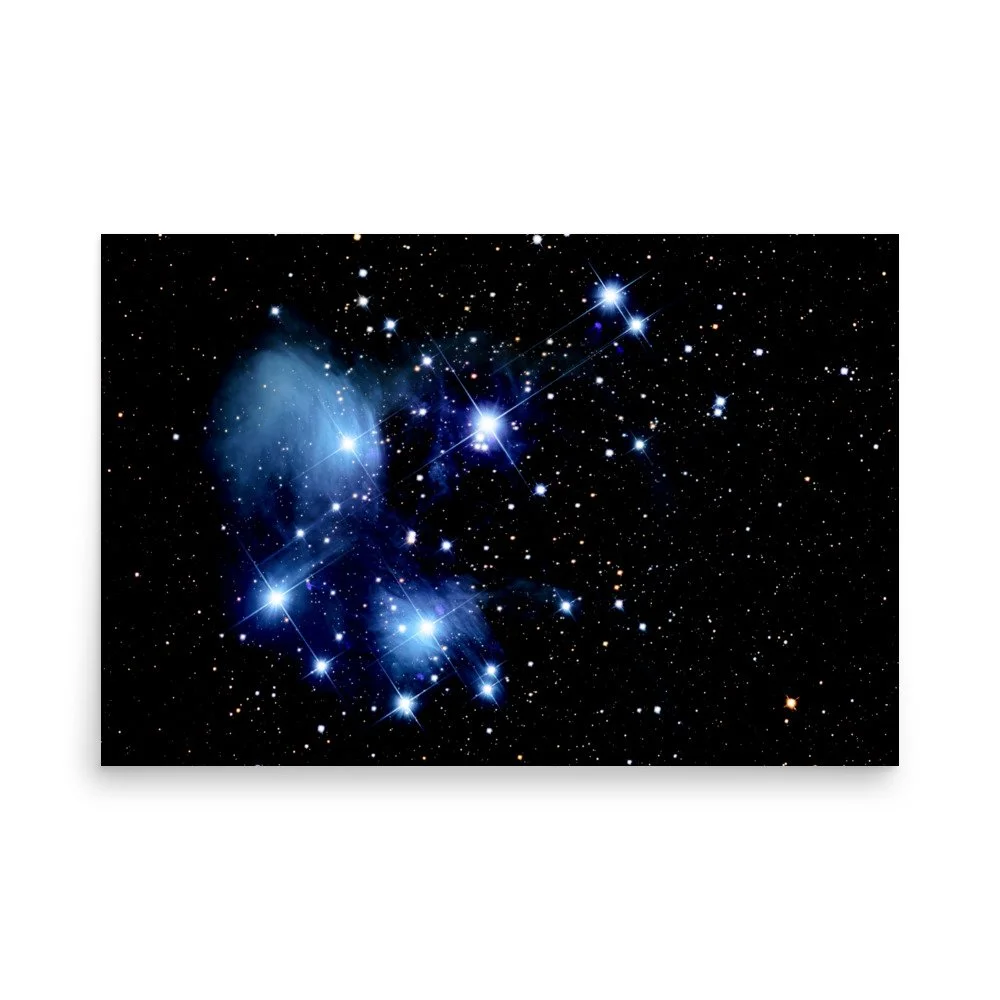
The Pleiades — the Seven Sisters — captured through my telescope. M45 is one of the closest star clusters to Earth at just 444 light-years away, and one of the brightest things in the night sky. You can see it with the naked eye in Taurus; you've probably already noticed it without knowing what it was.
What makes the Pleiades special on film is the blue. The cluster's hot young stars are passing through a cloud of interstellar dust, and that dust scatters their light back to us in soft, layered blue veils. It's a reflection nebula — not gas glowing on its own, but starlight being reflected like fog around a streetlamp. The result is one of the most beautiful blue-and-white scenes in deep space.
Real astrophotography. No AI, no stock. The Seven Sisters, brought down to your wall.
Read more →
What makes the Pleiades special on film is the blue. The cluster's hot young stars are passing through a cloud of interstellar dust, and that dust scatters their light back to us in soft, layered blue veils. It's a reflection nebula — not gas glowing on its own, but starlight being reflected like fog around a streetlamp. The result is one of the most beautiful blue-and-white scenes in deep space.
Real astrophotography. No AI, no stock. The Seven Sisters, brought down to your wall.
from $24.99
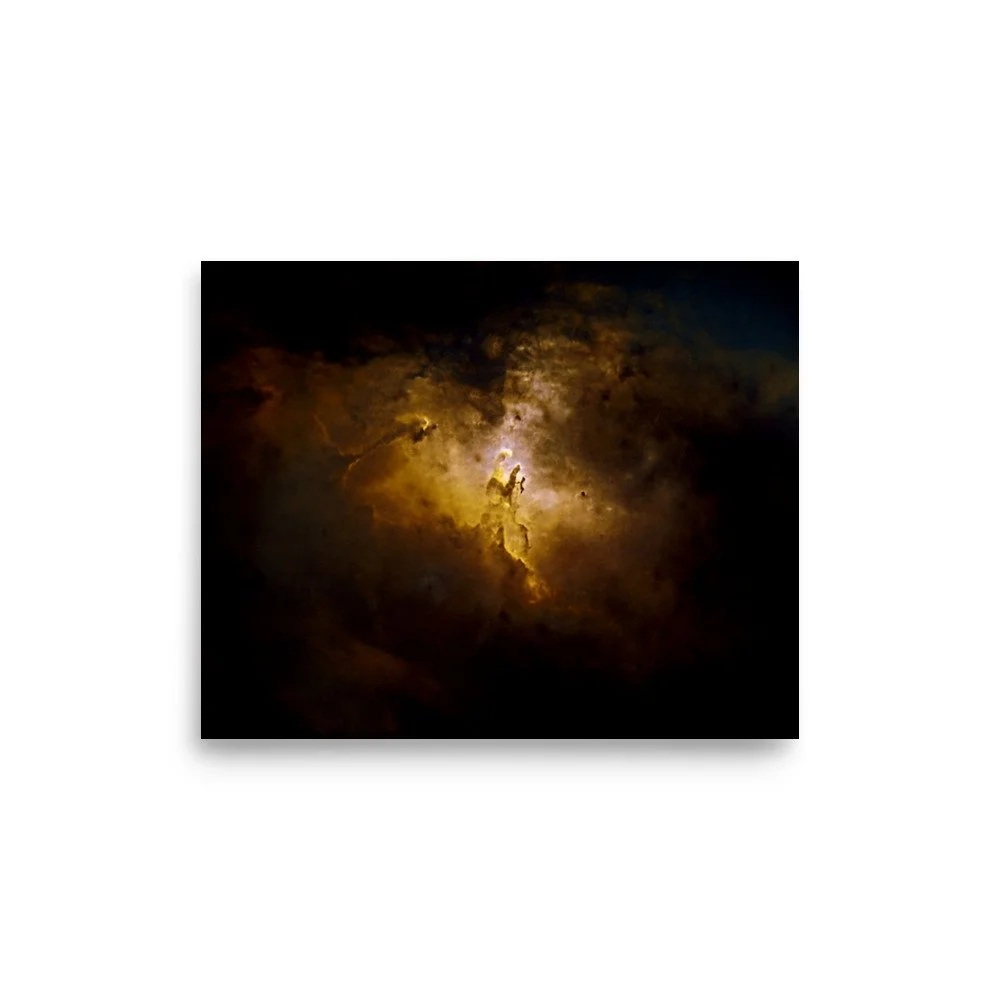
The Pillars of Creation on premium poster paper — the most recognizable structure in all of astronomy, captured through my own telescope. These columns of cold gas and dust tower light-years tall inside the Eagle Nebula (M16), roughly 5,700 light-years away in Serpens, where the radiation of nearby young stars is slowly eroding the pillars while new stars ignite at their tips.
Printed in a warm gold-and-amber palette. Real astrophotography — no AI, no stock — of the nebula Hubble made famous.
Read more →
Printed in a warm gold-and-amber palette. Real astrophotography — no AI, no stock — of the nebula Hubble made famous.
from $24.99
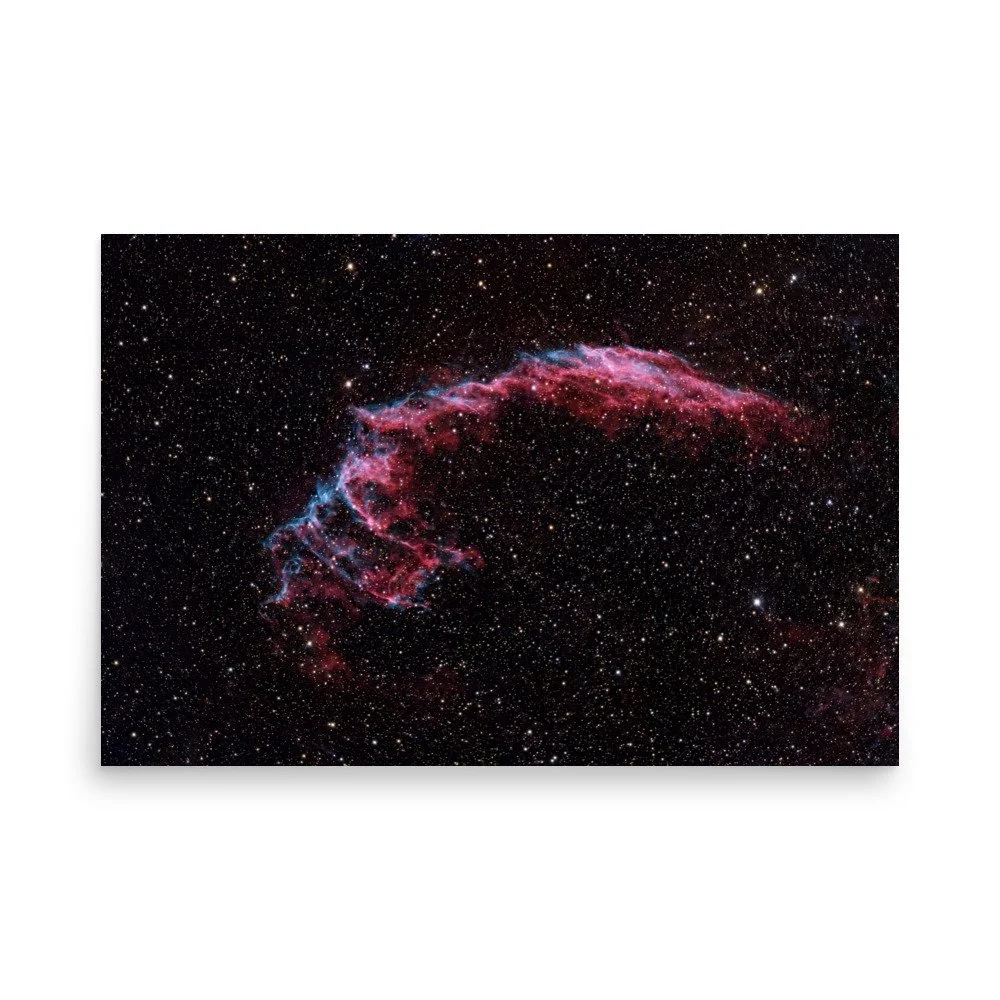
Capture the Bat Nebula's spread wings on your wall. This isn't a digital painting — it's NGC 6995, the glowing aftermath of a supernova drifting through the constellation Cygnus, photographed through my own telescope and printed on premium poster paper.
NGC 6995 is part of the Veil Nebula complex, the expanding remains of a massive star that exploded around 8,000 years ago. What you're looking at is real light from real gas, still racing outward across 2,400 light-years of space. The bat-like silhouette comes from how red hydrogen meets veins of teal oxygen — a shape carved by a star's death, held still in the moment the camera caught it.
Real astrophotography. No AI, no stock. Just deep sky on your wall.
Read more →
NGC 6995 is part of the Veil Nebula complex, the expanding remains of a massive star that exploded around 8,000 years ago. What you're looking at is real light from real gas, still racing outward across 2,400 light-years of space. The bat-like silhouette comes from how red hydrogen meets veins of teal oxygen — a shape carved by a star's death, held still in the moment the camera caught it.
Real astrophotography. No AI, no stock. Just deep sky on your wall.
from $24.99
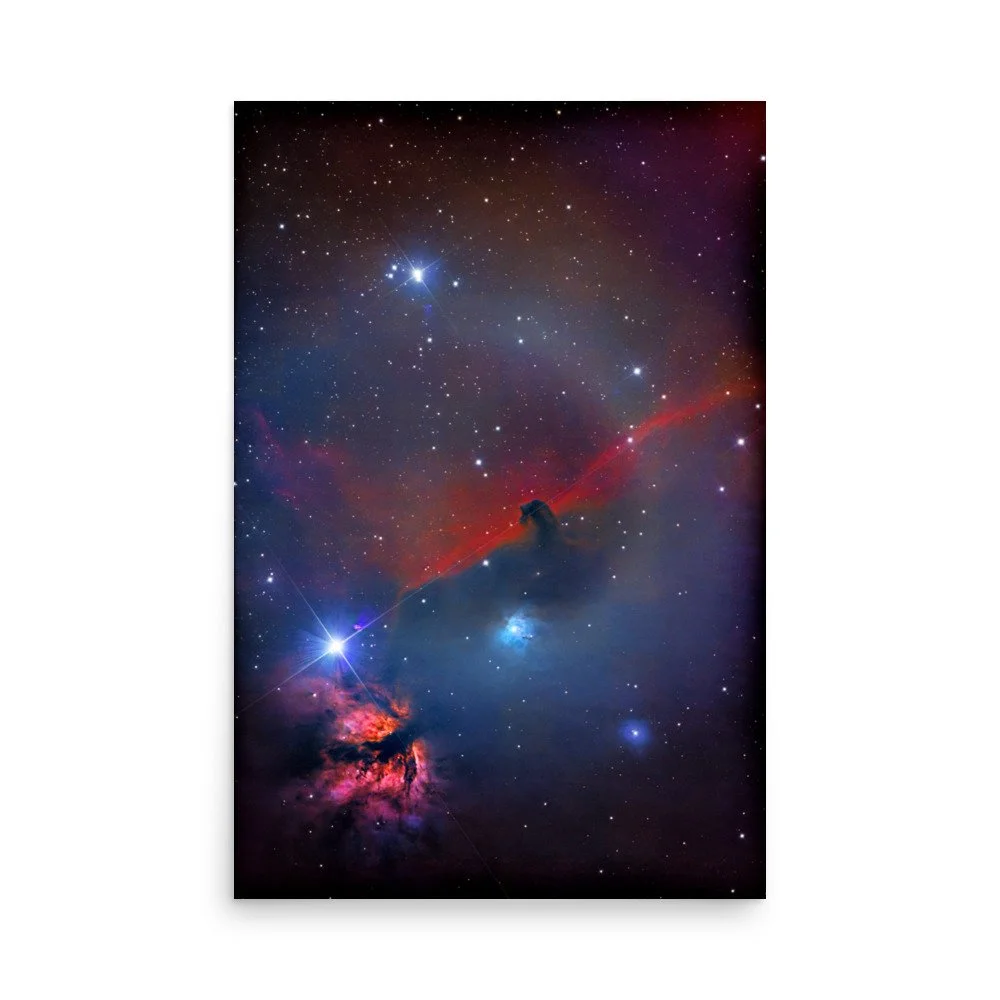
The Horse Head Nebula — Barnard 33, captured through my telescope. It sits in the constellation Orion, about 1,500 light-years from Earth, and it's one of the most recognizable shapes in the entire night sky. A silhouette of a horse's head, dark as ink, set against a backdrop of red glowing hydrogen.
What you're actually looking at is a dense cloud of cold dust blocking the light from the bright emission nebula IC 434 behind it. The horse shape itself is just opaque dust — what makes it visible is the brilliant red gas behind it lighting up the rest of the frame. It's one of the universe's better illusions: a shape made entirely of what isn't there.
Real astrophotography. No AI, no stock. Just deep sky on your wall.
Read more →
What you're actually looking at is a dense cloud of cold dust blocking the light from the bright emission nebula IC 434 behind it. The horse shape itself is just opaque dust — what makes it visible is the brilliant red gas behind it lighting up the rest of the frame. It's one of the universe's better illusions: a shape made entirely of what isn't there.
Real astrophotography. No AI, no stock. Just deep sky on your wall.
from $24.99
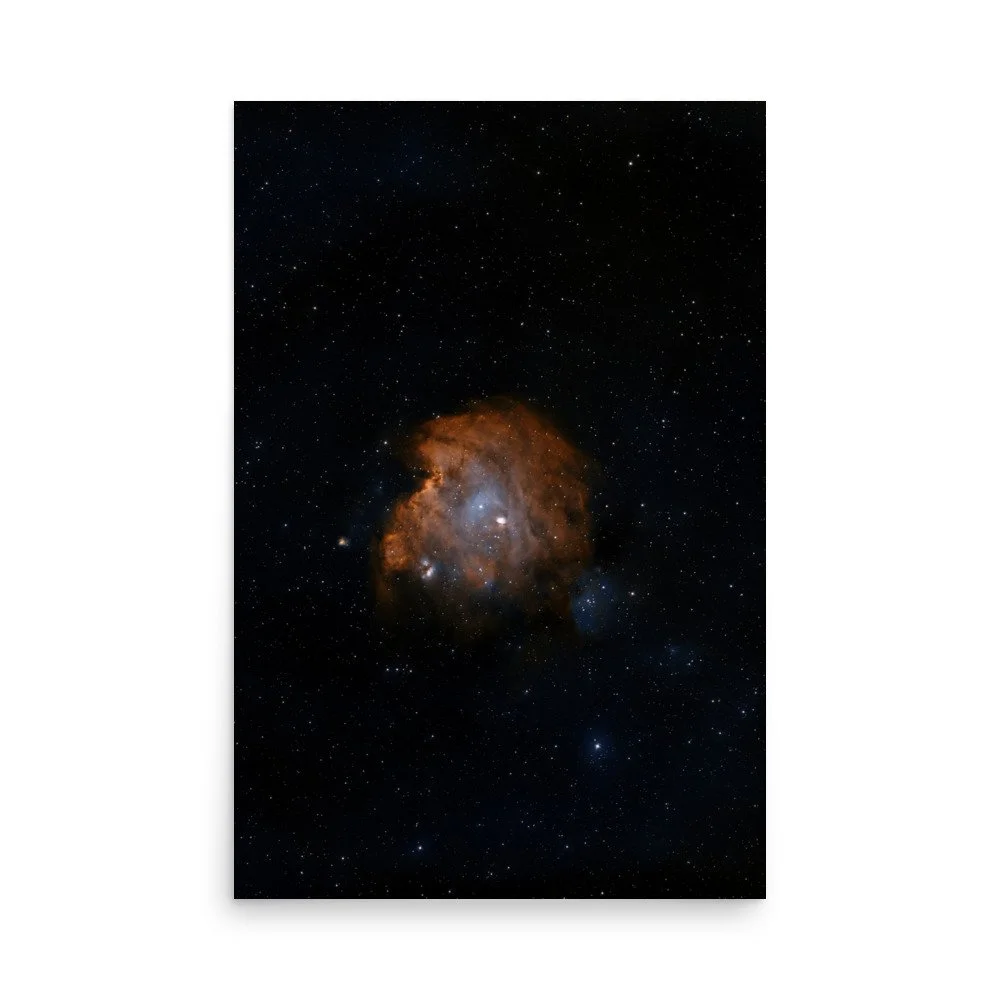
The Monkey Head Nebula — a stellar nursery 6,400 light-years away in the constellation Orion. NGC 2174 earned its nickname from its uncanny silhouette: when photographed and rotated just right, the bright knots and dark dust lanes form what looks unmistakably like a monkey's face peering back from deep space.
Behind the resemblance is a region of active star formation. The reds are hydrogen being ionized by young, hot stars embedded inside. The darker structures are dense pillars of dust where new stars are still being assembled — some of them slowly collapsing under their own gravity at this very moment.
Real astrophotography, captured through my own telescope. No AI, no stock. Just a face in the sky.
Read more →
Behind the resemblance is a region of active star formation. The reds are hydrogen being ionized by young, hot stars embedded inside. The darker structures are dense pillars of dust where new stars are still being assembled — some of them slowly collapsing under their own gravity at this very moment.
Real astrophotography, captured through my own telescope. No AI, no stock. Just a face in the sky.
from $44.99
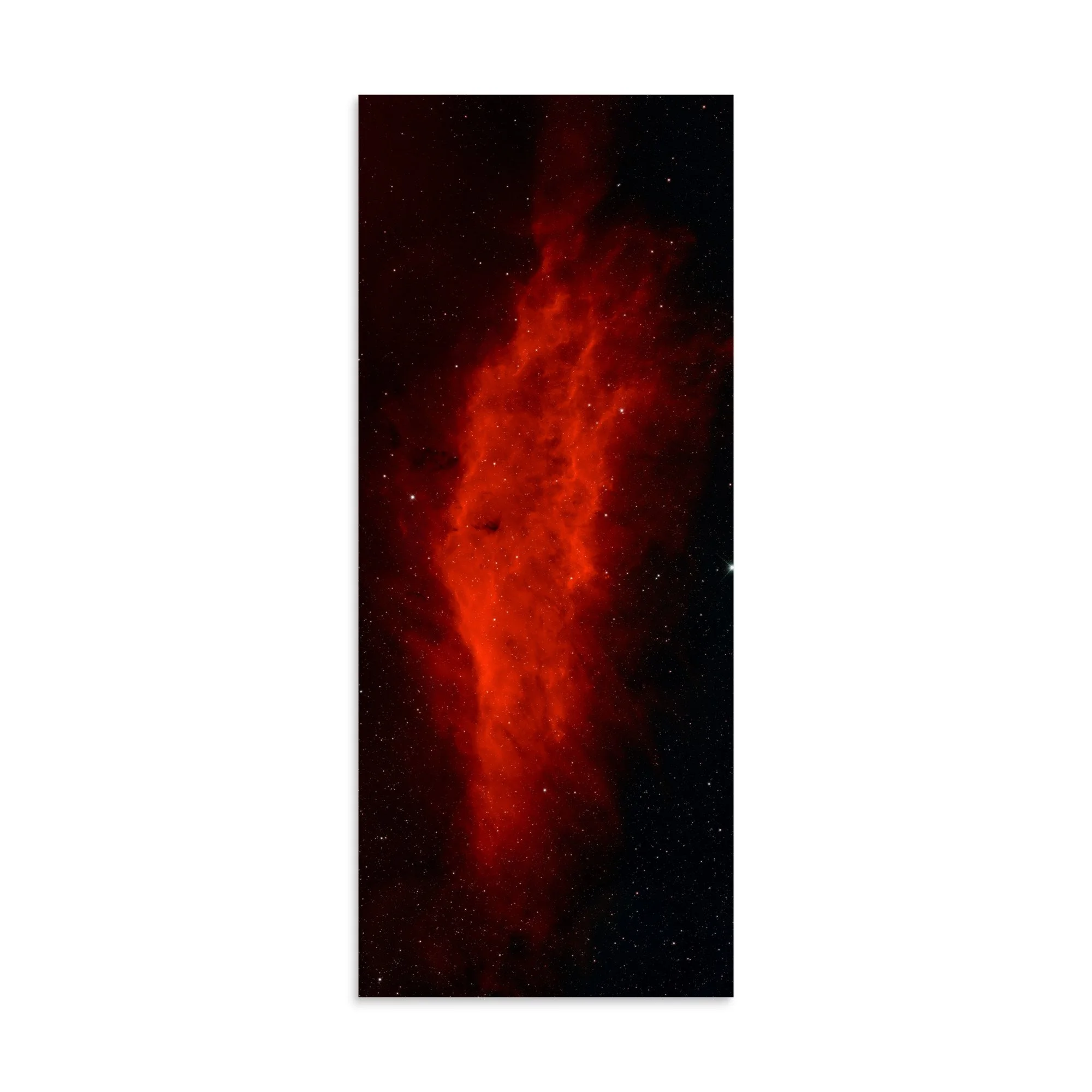
The California Nebula stretched across the wall — a hundred light-years of glowing hydrogen, captured through my own telescope and printed on premium paper. NGC 1499 gets its name from its uncanny resemblance to the outline of the state of California, and like the state, it's huge: nearly six times the width of the full moon as it appears in the sky.
What lights it up is a single nearby star — the hot blue giant Xi Persei, drifting past at ~1,000 light-years from Earth, ionizing the surrounding hydrogen as it goes. The result is that long, undulating red coastline, faint enough to be invisible to the naked eye but spectacular in long-exposure astrophotography.
Real astrophotography. No AI, no stock. Just deep sky on your wall.
Read more →
What lights it up is a single nearby star — the hot blue giant Xi Persei, drifting past at ~1,000 light-years from Earth, ionizing the surrounding hydrogen as it goes. The result is that long, undulating red coastline, faint enough to be invisible to the naked eye but spectacular in long-exposure astrophotography.
Real astrophotography. No AI, no stock. Just deep sky on your wall.
from $24.99
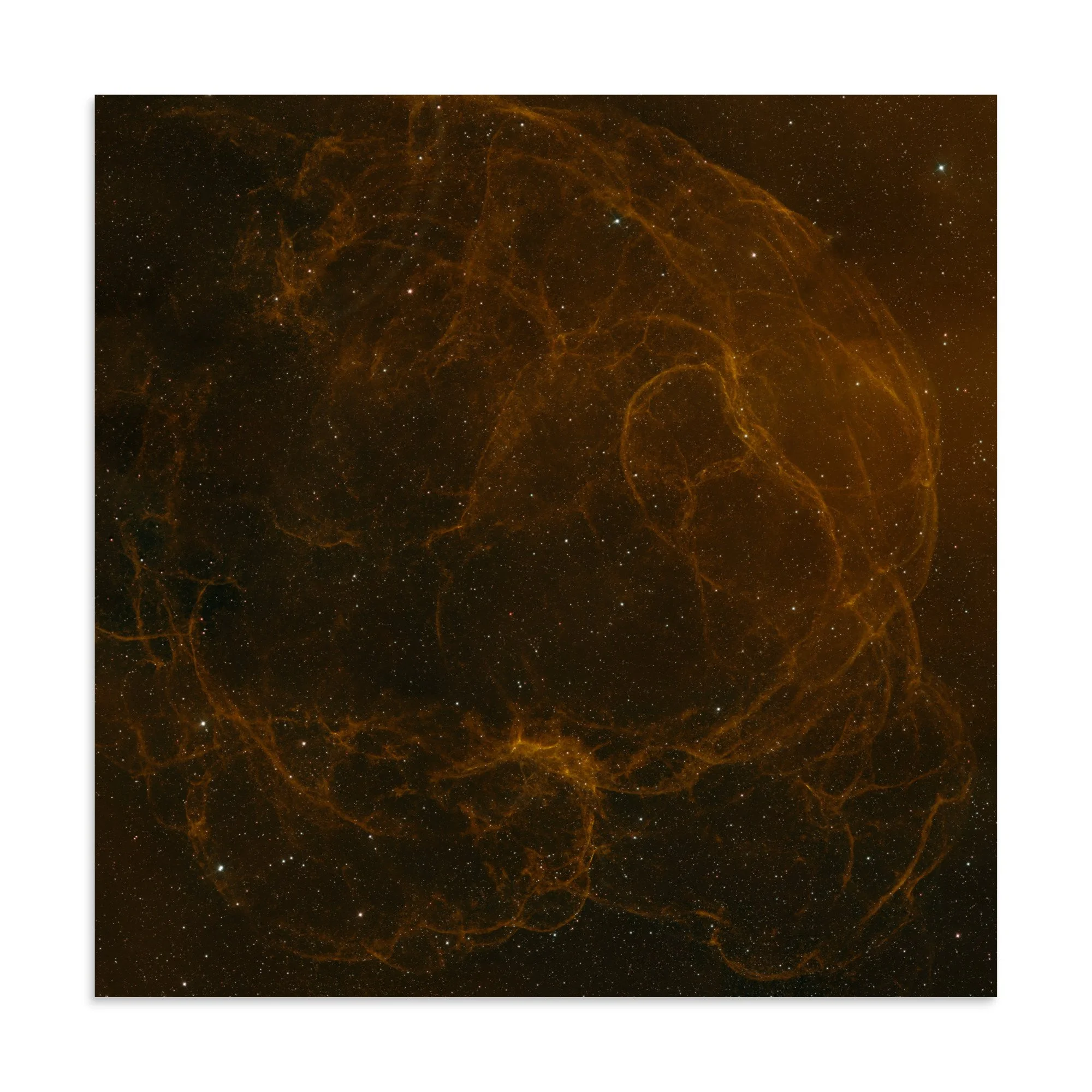
The Spaghetti Nebula — the tangled, glowing wreckage of a star that exploded around 40,000 years ago. Simeis 147 spans nearly six full-moon widths across the sky and sits about 3,000 light-years away in the constellation Taurus, but it's so faint it's nearly invisible without long-exposure imaging.
What you're seeing is the supernova's shockwave, still expanding outward through space all these millennia later. The filaments are gas that was once inside the dying star, now stretched into impossibly delicate threads as it cools and slows. Every wisp is a record of an explosion that happened before humans started farming. It is, quietly, one of the most beautiful objects in the sky.
Real astrophotography. No AI, no stock. Just deep sky on your wall.
Read more →
What you're seeing is the supernova's shockwave, still expanding outward through space all these millennia later. The filaments are gas that was once inside the dying star, now stretched into impossibly delicate threads as it cools and slows. Every wisp is a record of an explosion that happened before humans started farming. It is, quietly, one of the most beautiful objects in the sky.
Real astrophotography. No AI, no stock. Just deep sky on your wall.
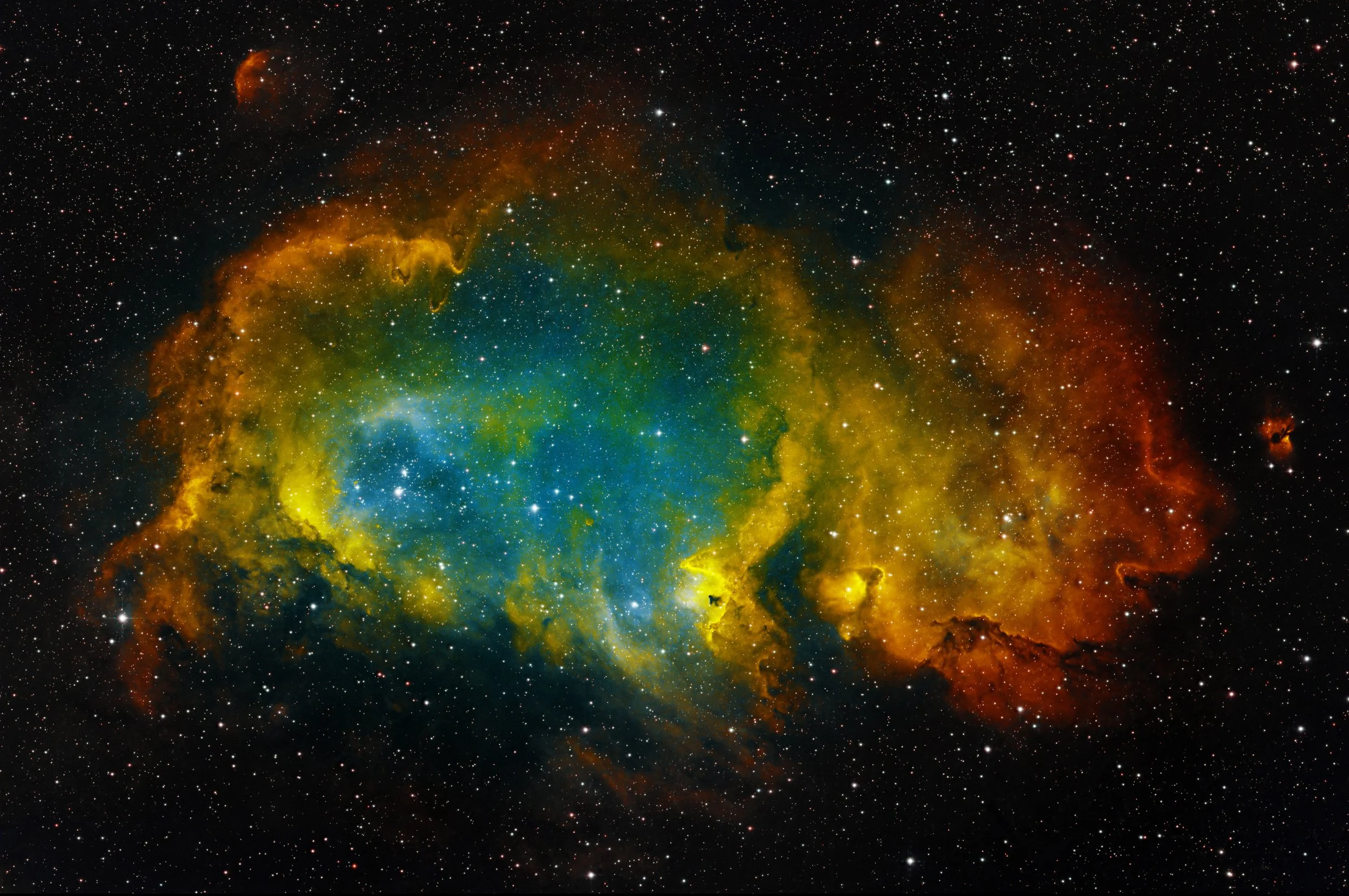
The "soul" name comes from the nebula's silhouette — to many it resembles a fetus or human form, an accidental cosmic Rorschach. What you're seeing is hydrogen gas being lit up by young stars embedded inside, pockets of new stars still being born in dense knots of dust. The red is the gas; the dark veins are the dust that hasn't been blown away yet.
Captured through my own telescope. No AI. No stock. Just deep sky on your wall.